 28 January 2026

By Publisher Ray Carmen
Imagine boarding an aircraft in London at breakfast time… and stepping off in Sydney before lunch.
No jet lag. No long haul. No lost days.
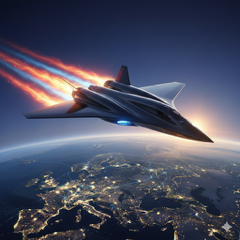
That once-impossible vision is suddenly racing toward reality after reports that China has developed a hypersonic aircraft capable of circling the Earth in just seven hours, reaching blistering speeds of up to 3,000 miles per hour.
If confirmed at scale, it would mark one of the most dramatic leaps in aviation since the invention of the jet engine.
What Is a Hypersonic Plane?
Hypersonic flight refers to speeds exceeding Mach 5 , more than five times the speed of sound. At 3,000 mph, this aircraft wouldn’t just fly through the sky , it would skim the edge of space, operating in the thin upper atmosphere where traditional aerodynamics begin to blur into orbital physics.
In simple terms:
This is not a faster Concorde.
This is an entirely new class of travel.
The End of Distance as We Know It
A seven-hour global flight would compress the planet in ways previously reserved for science fiction.
-
London to New York: under 90 minutes
-
Paris to Tokyo: around 3 hours
-
Dubai to Cape Town: just over 2 hours
Suddenly, continents become neighbours. Business, diplomacy, tourism, and even family life are reshaped. The very idea of “long-haul” disappears.
For island regions — including the Caribbean — this kind of technology could be transformational, turning once-remote paradises into effortlessly reachable destinations without sacrificing days of travel.
More Than Speed — It’s Power
Of course, hypersonic technology isn’t just about holidays.
Its implications stretch across:
-
Engineering
-
Climate research
-
Spaceflight crossover
-
Geopolitics and global influence
Mastery of hypersonic systems signals technological dominance. It tells the world: we can bend time, distance, and physics to our will.
That’s why this development has sent quiet shockwaves through aerospace circles worldwide.
Is This the Future of Commercial Flight?
Not immediately. Hypersonic travel still faces formidable challenges:
-
Extreme heat at sustained speeds
-
Fuel efficiency
-
Cost and accessibility
-
Environmental impact
-
Safety certification
But so did jet engines once.
So did commercial spaceflight.
So did electric cars.
Every aviation revolution begins as a headline that sounds unbelievable — until it doesn’t.
A World That Feels Smaller — and Bigger
There’s something oddly poetic about this moment.
As technology shrinks the planet, it also reminds us how precious it is. Faster travel doesn’t just mean convenience — it offers the possibility of deeper global understanding, cultural exchange, and shared responsibility.
If humanity can cross the world in seven hours, perhaps it can also learn to care for it more wisely.
The Takeaway
This isn’t just a story about China.
It’s a story about where humanity is heading next.
The sky is no longer the limit.
Time itself is the next frontier.
And once again, the future has arrived quietly — at 3,000 miles per hour.