 1 April 2026

By Publisher Ray Carmen
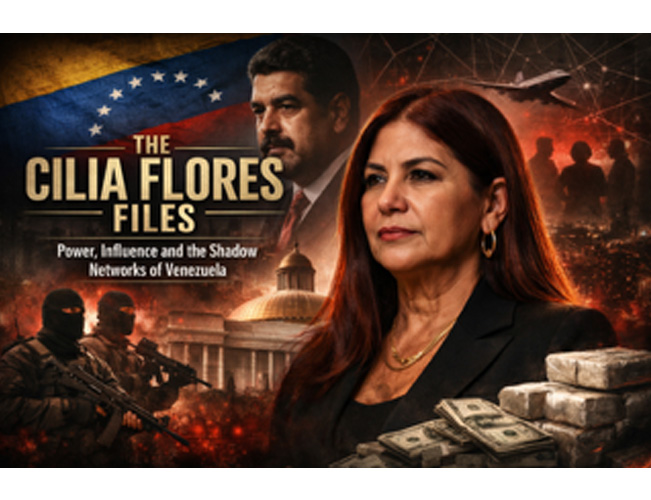
In the tightly controlled corridors of power in Venezuela, influence is rarely confined to official titles. It moves quietly, often invisibly, through trusted relationships, inner circles and longstanding loyalties. And few figures embody that dynamic more than Cilia Flores.
Long known to the world as a central figure alongside Nicolás Maduro, Flores has, over the years, evolved into something far more complex than a ceremonial presence. To supporters, she is a steadfast political operator and loyal partner in governance. To critics, she represents a deeper, more opaque layer of influence within Venezuela’s ruling elite.
What is beyond dispute is this: her proximity to power has placed her at the heart of one of the most scrutinised political systems in the world.
From Legal Mind to Political Power
Before entering the upper echelons of government, Flores built her reputation as a lawyer — a background that would later prove instrumental in navigating the complexities of political life in Caracas. Her rise was neither sudden nor accidental. It was methodical, rooted in years of institutional involvement and deep connections within the country’s political framework.
As Venezuela underwent profound transformation during the era of Hugo Chávez, Flores became an increasingly visible figure, aligning herself with the movement that would redefine the nation’s trajectory. Over time, her role expanded, placing her firmly within the inner circle that would shape the country’s future.
The Inner Circle
Power in Venezuela has long been understood not only through official positions, but through access — who is in the room, who is trusted, and who has the ear of leadership at critical moments.
In this regard, Flores’ influence is widely acknowledged. Observers of Venezuelan politics frequently point to her presence within the country’s most exclusive decision-making circles, where policy, strategy and political survival are often intertwined.
Her role has been described by analysts as both stabilising and strategic — a figure capable of navigating the pressures of domestic governance while maintaining cohesion within a leadership structure that has faced sustained international scrutiny.
Scrutiny and Controversy
With proximity to power inevitably comes scrutiny. Over the years, Flores has been the subject of allegations and investigations reported by international media and judicial authorities, particularly relating to individuals within her extended circle.
These developments have intensified global attention on Venezuela’s leadership, further complicating an already complex geopolitical landscape. While Flores herself has consistently denied wrongdoing, the narratives surrounding her have continued to fuel debate about transparency, accountability and governance in the country.
For critics, these issues point to systemic concerns. For supporters, they reflect the pressures of political opposition and international contestation.
A Symbol of Power — and Its Perception
In modern geopolitics, perception can be as powerful as reality. Flores has, in many ways, become a symbol — representing both the resilience and the controversy of Venezuela’s current political era.
Her presence alongside Maduro, both domestically and on the international stage, reinforces the image of a tightly held leadership structure — one that operates with a high degree of internal loyalty and control.
At the same time, that very image continues to attract attention, analysis and, at times, criticism from across the global community.
The Bigger Picture
The story of Cilia Flores is not simply about one individual. It is about how power functions in complex political systems — how influence is built, maintained and perceived.
In Venezuela, where politics, economics and international relations intersect in high-stakes fashion, figures like Flores offer a lens through which to understand the broader dynamics at play.
As the country continues to navigate internal challenges and external pressures, the role of those within its inner circle remains as consequential as ever.
Conclusion: The Story Still Unfolding
The “Cilia Flores Files” is not a closed chapter — it is an evolving narrative.
In a nation where power is both visible and veiled, Flores remains a figure of enduring significance. Whether viewed as a strategist, a loyalist, or a symbol of deeper systemic questions, her place within Venezuela’s story is firmly established.
And as global attention continues to focus on the country’s future, one thing is certain:
The world will be watching.