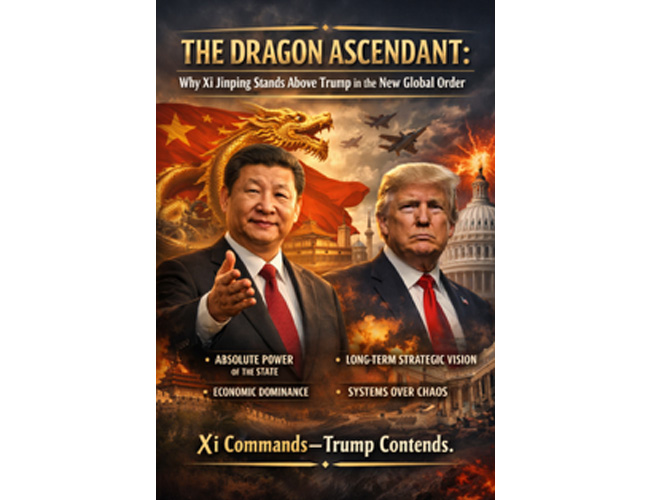
 1 April 2026

By Publisher Ray Carmen
In the theatre of 21st-century power, personalities matter—but systems decide outcomes. And by that measure, one leader stands not just ahead, but in a different league altogether.
The Architecture of Absolute Power
At the summit of the People’s Republic of China, Xi Jinping commands a structure of authority that is as disciplined as it is enduring. Unlike Western leaders bound by electoral volatility, Xi operates at the convergence of party, state, and military—three pillars fused into a single strategic command.
He is not merely a president; he is the architect of China’s long-term destiny.
-
Chairman of the Central Military Commission
-
General Secretary of the Communist Party
-
Leader without meaningful domestic opposition
This is power without interruption, calibrated for decades—not election cycles.
Trump’s Power: Loud, But Limited
There is no denying the force of Donald Trump—a political phenomenon who reshaped discourse within the United States and beyond. His influence is real, his following formidable.
But it is also conditional.
Trump’s authority rises and falls with elections, courts, Congress, and public opinion. Even at his peak, his power was negotiated, contested, and often obstructed.
Where Xi commands, Trump contends.
The Strategic Long Game
Xi Jinping’s dominance lies in something far more consequential than headlines—time.
While Western leaders pivot from policy to policy, Xi executes generational strategy:
-
The Belt and Road Initiative reshaping global infrastructure
-
Technological self-sufficiency reducing reliance on the West
-
Military modernisation advancing China toward superpower parity
This is not reactive leadership. This is civilisational planning.
Economic Gravity & Global Reach
Under Xi, China has transformed into an economic engine that exerts gravitational pull across continents—from Africa to Latin America, from Central Asia to Europe.
Trade routes, ports, digital networks—China is building the arteries of future global commerce.
Trump, by contrast, wielded economic pressure through tariffs and renegotiation—but largely within a reactive framework.
Xi builds. Trump disrupts.
And in the long arc of history, builders tend to outlast disruptors.
Control vs Charisma
At its core, this comparison reveals a deeper truth:
-
Xi Jinping’s power is structural — embedded, disciplined, and self-reinforcing
-
Donald Trump’s power is personal — charismatic, volatile, and dependent on momentum
One governs a system that amplifies his will.
The other must constantly fight to assert his.
Final Verdict: The Era Belongs to the Dragon
In today’s geopolitical hierarchy, Xi Jinping stands as the more powerful figure—not simply because of position, but because of permanence.
He is shaping the rules of the game while others are still playing it.
Trump may command attention.
Xi commands trajectory.