 26 March 2026

By Publisher Ray Carmen
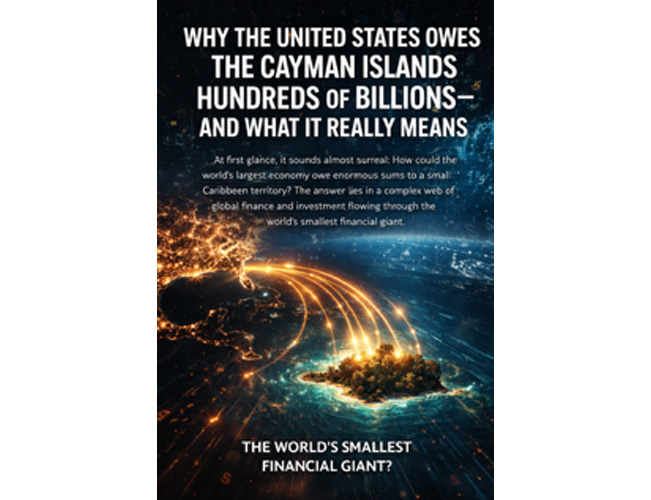
At first glance, it sounds almost surreal: how could the world’s largest economy owe hundreds of billions to a tiny Caribbean territory?
Yet financial data consistently shows that Cayman Islands–based entities hold vast quantities of U.S. assets,often framed as the United States “owing” the islands enormous sums.
The reality, however, is far more nuanced,and far more revealing about how modern finance truly works.
The Truth Behind the Numbers
The headline figure,often cited in the hundreds of billions,primarily reflects U.S. Treasury securities and other financial assets held through Cayman-registered entities.
In simple terms:
-
The Cayman Islands act as a global financial hub.
-
Institutional investors channel funds through Cayman vehicles.
-
These entities then invest heavily in U.S. debt and markets.
So while it appears that the Cayman Islands “own” a large portion of U.S. debt, the money often originates from:
-
Hedge funds
-
Pension funds
-
International corporations
-
Ultra-high-net-worth investors
Why the Cayman Islands?
The islands’ prominence isn’t about beaches,it’s about balance sheets. They have become a key financial centre thanks to:
-
Tax neutrality
-
Flexible regulatory structures
-
A strong legal framework based on English common law
-
Ease of structuring global investment funds
A Financial Illusion?
Calling it a “debt to the Cayman Islands” can be misleading.
In reality:
-
The U.S. owes money to whoever holds its debt instruments.
-
Cayman entities are often intermediaries, not the ultimate owners.
This creates a fascinating illusion: a small island appears to be a financial giant—simply by sitting at the centre of global capital flows.
Why It Matters
This isn’t just technical finance,it has tangible implications:
-
Global influence: Financial hubs quietly shape capital allocation.
-
Economic interdependence: Even superpowers rely on global investors.
-
Regulatory debates: Offshore finance remains a hot political topic.
It also highlights a deeper truth: power today is not only held by nations,but by networks of capital moving invisibly across borders.
The Bigger Picture
The relationship between the U.S. and the Cayman Islands is not one of dominance,but of financial symbiosis.
-
United States provides: Stability, markets, global reserve currency
-
Cayman Islands provides: Structure, access, efficiency for global capital
Closing Thought
The headline number may grab attention—but the real story is far more powerful.
In the modern world: money doesn’t belong to places. It moves through them.