 24 April 2026

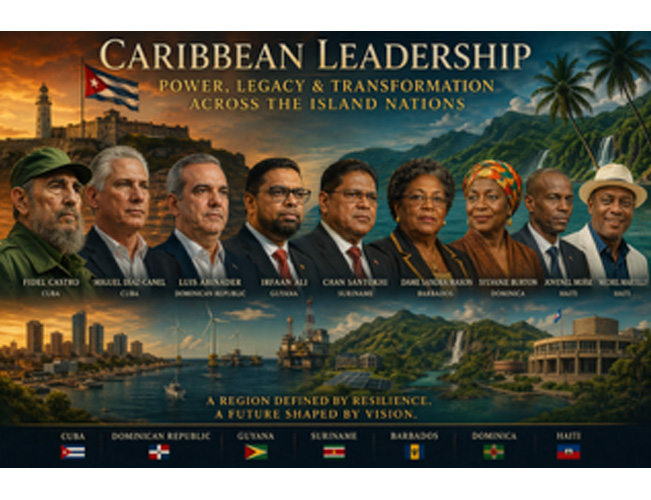
1. Cuba — Fidel Castro & Miguel Díaz-Canel
Fidel Castro
Miguel Díaz-Canel
Few leaders in modern history have shaped a nation as profoundly as Fidel Castro. As the architect of post-revolution Cuba, his policies redefined healthcare, education, and global alignment during the Cold War era.
Today, Miguel Díaz-Canel continues to navigate Cuba through a complex modern reality—balancing legacy systems with gradual economic adaptation.
Legacy: Revolution, ideology, and enduring global symbolism.
2. Dominican Republic — Luis Abinader
Luis Abinader
A business-oriented reformer, Abinader has focused on transparency, investment growth, tourism expansion, and institutional reform in one of the Caribbean’s fastest-growing economies.
Legacy: Modernisation and economic confidence in the Caribbean’s most dynamic mainland economy.
3. Guyana — Irfaan Ali
Irfaan Ali
Leading one of the world’s fastest-growing energy economies due to offshore oil discoveries, Ali has positioned Guyana at the centre of global investment attention while managing environmental and social transformation pressures.
Legacy: Rapid economic expansion and emerging geopolitical relevance.
4. Suriname — Chan Santokhi
Chan Santokhi
A former police chief turned president, Santokhi has focused on stabilising Suriname’s economy, strengthening governance, and addressing debt restructuring challenges.
Legacy: Institutional reform and economic stabilisation.
5. Barbados — Dame Sandra Mason
Sandra Mason
As Barbados transitioned into a republic in 2021, Sandra Mason became its first president, marking a historic break from the British monarchy. Her leadership symbolises a new era of national sovereignty and identity.
Legacy: Post-colonial transition and constitutional transformation.
6. Dominica — Sylvanie Burton
Sylvanie Burton
The first female president of Dominica and the first from the Kalinago Indigenous community, Burton represents cultural inclusion and environmental stewardship in a nation known for its ecological leadership.
Legacy: Indigenous representation and ecological governance.
7. Haiti — Jovenel Moïse (Legacy Presidency)
Jovenel Moïse
Haiti’s leadership history is complex and often unstable, but Moïse’s presidency remains significant for his attempts at constitutional reform and infrastructure development before his assassination in 2021.
Legacy: Reform ambition amid political instability.
8. Haiti — Michel Martelly
Michel Martelly
A former musician turned president, Martelly brought a populist style to Haitian politics, focusing on post-earthquake recovery and education initiatives.
Legacy: Cultural leadership in a post-crisis nation.
The Caribbean Leadership Identity
Unlike larger global powers, Caribbean presidents often govern within unique constraints:
- Small economies with global exposure
- High dependence on tourism, energy, or agriculture
- Vulnerability to climate change
- Deep colonial historical legacies
- Strong cultural identity and diaspora influence
Yet despite these challenges, Caribbean leadership has consistently produced figures who influence global diplomacy, climate policy, energy markets, and cultural identity.
Final Word
The Caribbean does not measure leadership by scale—but by resilience under pressure and clarity of vision in small but globally significant nations.
From revolutionary states to emerging democracies, these presidents reflect a region constantly redefining itself between history and modernity.
And in that balance lies the true story of Caribbean leadership.