 24 April 2026

By Publisher Ray Carmen
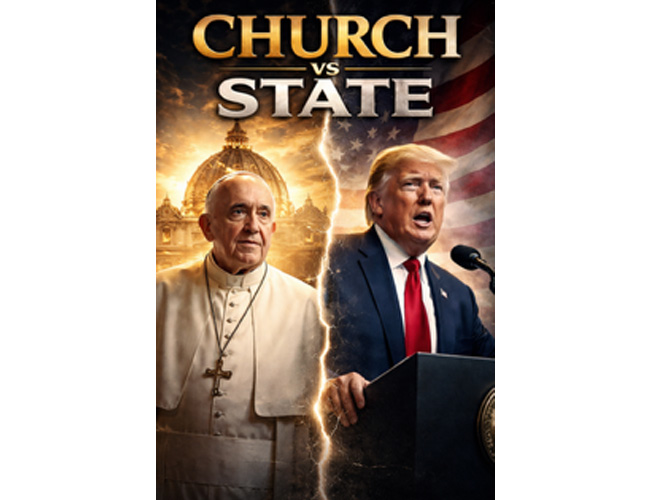
In the grand theatre of global power, few rivalries feel as symbolically charged as that between the spiritual authority of the Vatican and the political might of the United States. At the centre of this modern tension stand two vastly different figures: Pope Francis and Donald Trump.
One speaks the language of compassion, humility, and global unity.
The other, the rhetoric of nationalism, strength, and unapologetic sovereignty.
Together, they represent a deeper clash—Church vs State in the 21st century.
Two Men, Two Missions
From the balconies of St. Peter’s Basilica, Pope Francis has consistently championed the poor, the migrant, and the marginalized. His worldview is rooted in centuries-old Catholic doctrine—but adapted for a globalised, fragile world.
Across the Atlantic, Donald Trump rose to power on a radically different message: America First. Borders over bridges. Strength over softness. National identity over global obligation.
Their ideological divergence was not subtle—it was seismic.
The Flashpoints
The tension between the Vatican and Trump’s America became unmistakable during the height of the migration crisis.
* Pope Francis called for compassion and open-hearted policies toward refugees.
* Trump pushed for walls—literally and politically—most notably along the U.S.-Mexico border.
In a rare and striking moment, Pope Francis suggested that those who build walls instead of bridges are “not Christian.”
Trump fired back, calling such remarks “disgraceful.”
This was no longer diplomacy.
This was doctrine vs dominance.
Faith vs Nationalism
At its core, this clash reflects a deeper philosophical divide:
* The Church, embodied by Pope Francis, promotes universal moral responsibility.
* Trump’s political doctrine promotes national self-preservation first.
Where the Vatican sees humanity as one family, Trump-era politics often sees nations as competitors in a zero-sum world.
And yet,millions of American Christians supported Trump.
Why?
Because for many, issues like religious freedom, judicial appointments, and abortion policy aligned more closely with Trump’s agenda than with the Pope’s broader global messaging.
America’s Constitutional Paradox
The United States was founded on the principle of separation between church and state—a legacy enshrined in its Constitution.
Yet religion has never truly left American politics.
From presidential inaugurations to Supreme Court rulings, faith remains woven into the fabric of governance. The friction between spiritual guidance and political authority is not new—but under Trump, it became more visible, more vocal, and more polarised than ever before
The Global Ripple Effect
This was not merely an American story.
When the Pope speaks, over a billion Catholics listen.
When a U.S. president acts, the world reacts.
The tension between these two figures echoed across Europe, Latin America, Africa, and beyond—fueling debates about migration, identity, morality, and leadership in an increasingly divided world.
Beyond Personalities
To reduce this clash to personalities alone would be to miss the point.
This is not just about Pope Francis vs Donald Trump.
It is about:
* Globalism vs Nationalism
* Compassion vs Control
* Moral Authority vs Political Power
And perhaps most importantly
Who gets to define what is “right” in a fractured modern world?
Final Word
In the end, the “Church vs State” divide in America is less a battle—and more an ongoing negotiation.
A negotiation between conscience and control.
Between values and votes.
Between heaven… and earth.
And as long as leaders like Pope Francis and Donald Trump command global attention, that conversation is far from over.