 24 April 2026

By Publisher Ray Cramen
Inside the Havana Classic Car Museum
In Cuba, time does not stand still—it cruises.
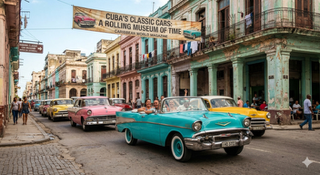
Across the streets of Havana, the past refuses to fade into history books. Instead, it roars to life in chrome, fins, and pastel-painted steel. The island is home to one of the most extraordinary living automotive collections on Earth: a moving museum of 1950s American classic cars still in daily use.
This is not nostalgia preserved behind glass.
This is nostalgia driving taxis, carrying families, and echoing through revolution-scarred streets.
The Rolling Icons of Cuba
When trade restrictions froze car imports in the late 1950s, Cuba became an unintended time capsule. American Chevrolets, Fords, Buicks, and Cadillacs were carefully maintained, repaired, and reinvented with extraordinary ingenuity.
Today, these vehicles are:
- Daily taxis for locals and tourists
- Wedding cars in Havana’s old streets
- Carefully restored collector pieces
- Family heirlooms passed through generations
Each car tells a story—not just of design, but of survival.
A 1957 Chevrolet is not just a machine in Cuba.
It is a living artefact of resilience and adaptation.
The Art of Survival Engineering
What makes Cuban classic cars unique is not just their age—but their transformation.
With limited access to original parts, Cuban mechanics became artists of improvisation:
- Engines rebuilt using Soviet and locally engineered components
- Interiors reupholstered with whatever materials were available
- Paintwork kept alive through constant restoration
- Hybrid systems created long before “hybrid” became a global term
The result is a parallel automotive universe—where a 1950s Cadillac may run with a diesel engine from a truck, and a Buick might carry parts from three different decades.
Havana’s Open-Air Car Culture
In Havana, the cars are not exhibits—they are part of the city’s identity.
You’ll see:
- Candy-coloured convertibles cruising the Malecón
- Drivers offering “old car tours” through colonial streets
- Jazz drifting from open windows at sunset
- Photographers capturing rolling silhouettes against faded colonial architecture
The city itself feels choreographed around these machines, as if Havana and its cars were designed for each other.
The Havana Classic Car Museum
At the heart of this automotive heritage lies the Havana Classic Car Museum, officially known as the Museo del Automóvil.
Inside, the story deepens.
This museum is not just about display—it is about context, memory, and political history on wheels.
Visitors can explore:
- Presidential vehicles from pre-revolution Cuba
- Rare American models from the early 20th century
- Military and state cars used during key historical moments
- Fully restored luxury vehicles preserved in pristine condition
Unlike the streets outside, where cars evolve through necessity, the museum preserves them in original historical form—a frozen archive of Cuba’s automotive past.
More Than Machines: Cultural Symbols on Wheels
Cuban classic cars represent more than transportation.
They symbolise:
- The endurance of Cuban ingenuity
- The blending of American design and Cuban resilience
- A unique economic adaptation under global isolation
- A living cultural identity that refuses to modernise away its past
In many ways, these cars are Cuba itself—beautiful, resourceful, imperfect, and unforgettable.
A Living Museum, Not a Dead One
What makes Cuba’s car culture so extraordinary is that it has avoided the fate of becoming purely nostalgic.
Elsewhere in the world, classic cars are polished, stored, and exhibited.
In Cuba, they are:
- Driven every day
- Maintained through necessity
- Reborn through creativity
- And constantly evolving
The museum is not just indoors.
The entire island is the museum.
Final Word
To walk through Havana is to step into a moving archive of global automotive history.
These cars are not preserved by wealth or luxury—but by ingenuity, pride, and necessity.
They remind the world that beauty does not always come from perfection.
Sometimes it comes from survival.
And in Cuba, survival has never looked more beautiful.