 24 April 2026

By Publisher Ray Carmen
Few events in modern history have reshaped a nation’s identity as profoundly as the Cuban Revolution. It was not just a political overthrow—it was a seismic cultural and ideological shift that turned a Caribbean island into one of the most closely watched nations on Earth.
To understand Cuba today, you must understand the moment everything changed.
The World Before the Revolution
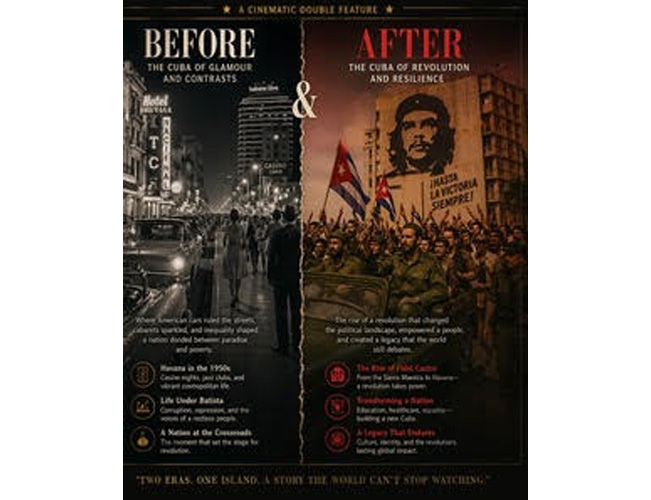
Before 1959, Cuba was a nation of stark contrasts.
Havana, in particular, was a playground for American tourism and organised crime networks. Luxury casinos, high-rise hotels, and nightlife flourished—while deep inequality shaped life for many Cubans outside the capital.
Under the government of Fulgencio Batista, corruption and political repression intensified, while foreign influence—especially from the United States—was deeply embedded in the island’s economy and entertainment industry.
Cuba was vibrant, but fractured.
The Rise of Fidel Castro
Out of this instability emerged a movement led by Fidel Castro, a young lawyer turned revolutionary who believed Cuba’s future lay in radical transformation.
Alongside key figures such as Ernesto “Che” Guevara, Castro’s 26th of July Movement began a guerrilla campaign from the Sierra Maestra mountains in the mid-1950s.
Their message was simple but powerful:
- End corruption
- Remove foreign domination
- Redistribute wealth
- Rebuild Cuba for Cubans
The movement gained momentum quickly, fueled by rural support and growing urban unrest.
1959: The Turning Point
On January 1, 1959, Batista fled Cuba.
Revolutionary forces entered Havana, marking the collapse of the old regime and the beginning of a new political era.
Castro soon assumed leadership, and Cuba began a sweeping transformation:
- Nationalisation of industries
- Land reforms and redistribution
- Expansion of education and healthcare
- Alignment with socialist ideology
The island’s direction shifted dramatically, positioning it at the centre of Cold War geopolitics.
Cold War Flashpoint
The Cuban Revolution did not remain an isolated national event. It quickly became a global issue.
Tensions escalated between Cuba and the United States, leading to:
- The Bay of Pigs Invasion (1961)
- The Cuban Missile Crisis (1962), one of the closest moments the world came to nuclear war
- Long-term economic embargoes and diplomatic isolation
Cuba became a symbol—both admired and criticised—depending on global perspective.
Che Guevara: The Global Icon
Among the revolution’s most enduring figures was Ernesto “Che” Guevara.
His image—beret, star, determined gaze—became one of the most reproduced symbols in modern history. But beyond the iconography, Che represented the revolutionary ideal of international struggle and ideological commitment.
His legacy remains deeply polarising, but undeniably influential in global political culture.
Life After the Revolution
The post-revolutionary period reshaped Cuban society:
- Universal literacy campaigns
- Strong public healthcare system
- State-controlled economy
- Cultural emphasis on equality and collective identity
At the same time, economic challenges, migration waves, and political restrictions defined everyday life for many Cubans.
Cuba became both a model and a controversy—depending on where you stood in the ideological spectrum.
The Cultural Revolution
Beyond politics, the revolution also reshaped culture.
Music, art, and literature became tools of identity. Afro-Cuban traditions were re-evaluated and elevated. Revolutionary themes influenced everything from cinema to street art.
Even today, Cuba’s cultural expression carries echoes of that transformative period—especially in Havana’s music scene, visual arts, and public spaces.
Cuba Today: A Living Aftershock
Modern Cuba is not frozen in 1959—but it still carries its imprint.
Classic cars still roam the streets. State institutions still reflect revolutionary ideology. Tourism, culture, and limited economic reforms now coexist with historical legacy.
The revolution is not just history here—it is structure, memory, and identity.
Final Word
The Cuban Revolution was not simply a change of government.
It was a rewriting of a nation’s DNA.
It created heroes and controversies, progress and constraint, unity and division—but above all, it created a country unlike any other.
To understand Cuba is to understand that revolutions do not end when the fighting stops.
They continue—quietly, culturally, and eternally—through the people who live within them.