 22 December 2025

By Publisher Ray Carmen
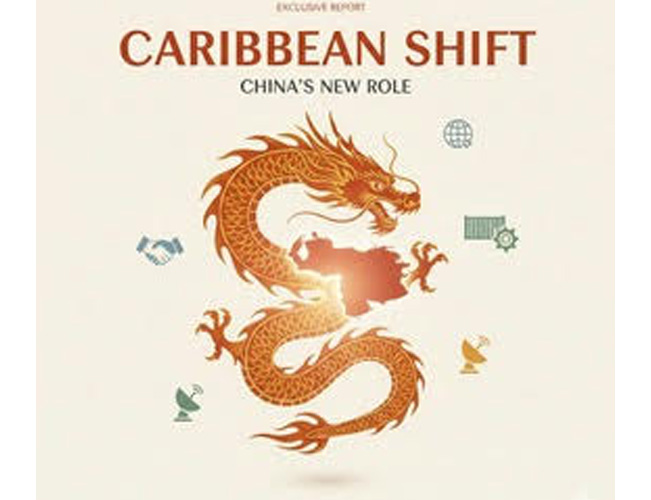
There’s been a lot of chatter online — especially on Facebook — claiming that China has now directly intervened in an unfolding crisis in the Caribbean. Let’s unpack what’s actually happening, what Beijing has done, and what commentators likely mean when they talk about “intervention.”
1. China’s Official Response to the Venezuela Situation
China has publicly weighed in on the escalating Venezuelan crisis, which forms the centrepiece of regional tensions that spill into the Caribbean basin.
-
Beijing has condemned U.S. economic and military pressure on Venezuela, calling actions like sanctions and blockades “unilateral bullying” and reaffirming its support for Venezuelan sovereignty. However, China has not sent troops, military hardware, or a combat force into the Caribbean or Venezuela. Instead, its “intervention” has so far been diplomatic and rhetorical — publicly defending Caracas and urging restraint from external powers.
-
In concrete terms, China did not commit direct military support when asked; Beijing stressed that it would not automatically intervene to protect President Nicolás Maduro against U.S. pressure. Analysts say China seeks to avoid a direct clash with Washington while protecting its economic interests.
So, while China speaks out, it has not deployed forces in the Caribbean theatre.
2. Behind the Headlines: China’s Broader Caribbean Strategy
What is true is that China’s engagement with Caribbean nations has been growing steadily — but mostly through diplomacy, investment, and development cooperation, not military means:
-
China recently released a new policy paper on Latin America and the Caribbean, where it outlined its plans for deeper economic, technological, and multilateral cooperation with Caribbean states. The document marks one of the highest-level strategic commitments China has made to the region in years.
-
Chinese Foreign Minister Wang Yi hosted Caribbean foreign ministers in Beijing, reaffirming China’s partnership and offering economic and people-to-people exchanges, assistance with development, scholarships and disaster response cooperation. These meetings reinforce relationships but are not military interventions.
-
Separate aid shipments — such as China sending disaster relief for hurricane victims in Cuba — are humanitarian support, not crisis intervention in a security sense.
3. Why Everyone Is Talking About “Intervention”
The viral claim you saw online likely conflates a few real but distinct realities:
Russia, China and other global powers are now politically aligned with Venezuela.
Venezuela’s requests for foreign support have prompted public outreach by China and Russia amid U.S. pressure. That makes it look like “intervention” in public discourse, even when it’s mostly diplomatic support.
China voicing opposition to U.S. actions can sound like direct involvement.
Beijing’s statements — that the U.S. should replace military anti-drug efforts with normal policing — were presented by state media as defending “sovereignty,” but they are policy positions, not military moves.
4. The Bigger Picture: Strategic Influence, Not War
What is undeniably true is that China has become a major geopolitical player in the Caribbean and Latin America:
-
China is one of the largest trading partners of many Latin American and Caribbean states and has championed infrastructure and technology investments through the Belt and Road Initiative.
-
Caribbean countries increasingly coordinate with Beijing in multilateral forums, underscoring shared development goals and mutual diplomatic support.
But military intervention — boots on the ground, warships on patrol — has not happened. What’s occurring is strategic diplomacy, economic partnership and political alignment, all amid an already fraught hemispheric environment involving the U.S. and Venezuela.
Bottom line:
China’s latest actions in the Caribbean are real — but they are diplomatic and economic, not a military intervention.What might feel like “direct involvement” online is best understood as geopolitical positioning and public support for partners like Venezuela, not boots or warships entering the region.