 31 January 2026

By Publisher Ray Carmen
Cuba is not merely an island, it is a temperament.
A rhythm.
A quiet defiance that lives in its people long after the speeches have faded and the banners have frayed.
To understand Cuba, one must look beyond the politics, beyond the slogans, beyond even the long shadow of Fidel Castro himself. Because while Fidel shaped the island’s destiny on the world stage, it was ordinary Cubans — resilient, warm, endlessly inventive — who shaped its soul.
The Island That Refused to Bend
History has tested Cuba harder than most. Decades of isolation, embargoes, shortages, and political rigidity might have broken another nation. Yet Cuba refused to bend. It adapted.
Here, resilience is not performative — it is inherited. Passed down like a family recipe. Cubans learned early how to make something from nothing, to repair what could not be replaced, to laugh when logic suggested despair.
Fidel Castro’s revolution promised dignity, independence, and defiance against global power. What followed was complicated — a mixture of pride, sacrifice, control, and consequence. But one thing is undeniable: the Cuban people learned how to survive with their heads held high.
Smiles Behind the Struggle
Walk the streets of Havana and you’ll notice something remarkable. Despite crumbling buildings and faded paint, the smiles are genuine. Conversations are warm. Music spills from doorways. Neighbours sit together at dusk, talking as if time itself has slowed to accommodate them.
In Cuba, joy is not ignorance — it is resistance.
Years under Castro-era policies taught Cubans to value people over possessions, presence over profit. Family, friendship, and community became currencies stronger than money. In a world obsessed with accumulation, Cubans mastered contentment.
More Than a Revolution
Fidel Castro remains one of the most polarising figures of the 20th century — revered by some, criticised by others, impossible to ignore. His vision reshaped Cuba’s systems, aligned it against superpowers, and etched the island permanently into global consciousness.
But Cuba’s greatest export was never ideology.
It was its people.
Doctors sent abroad. Artists who turned scarcity into beauty. Musicians who carried the island’s heartbeat across oceans. Ordinary citizens who learned how to live fully within limitations imposed from above and beyond their control.
Music, Memory, and the Spirit That Couldn’t Be Controlled
Even in periods of tight political control, Cuban creativity refused to dim. Salsa, son, jazz, poetry, art — culture flowed freely where policy could not.
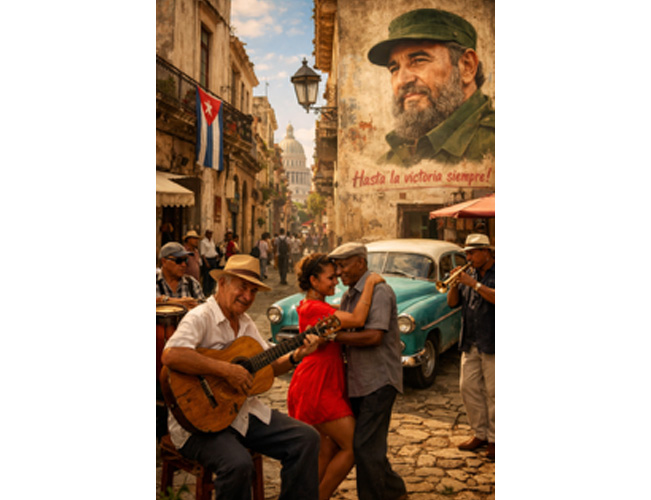
Old Havana hums with memory. Murals of Fidel gaze down from weathered walls, watching over streets where music still dances defiantly into the night. The revolution may have governed bodies, but it never fully captured imagination.
Culture became Cuba’s quiet rebellion.
Two Stories, One Island
There are always two Cubas.
Fidel’s Cuba , the speeches, the ideology, the global standoffs.
And the people’s Cuba , the laughter, the warmth, the faith, the ability to endure without bitterness.
Fidel shaped the island’s politics.
The people shaped its heart.
Cuba’s Quiet Power
Today, Cuba continues to exert influence far beyond its size. Not through force, but through soft power , diplomacy, culture, medicine, and moral authority born of survival.
The world still cannot ignore Cuba because Cuba never surrendered its humanity.
Under the Same Sun
Cuba lives loud. Not in noise, but in spirit. It endures, laughs, and loves under the same Caribbean sun that has witnessed empires rise and fall.
Hardship never killed joy here , it sharpened it.
And long after Fidel Castro’s voice fell silent, the Cuban people continue to speak , not in slogans, but in smiles, music, and the unbreakable rhythm of life.