Breaking News

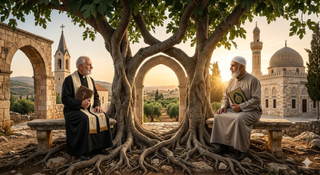
Christianity and Islam: Two Faiths, One Shared Root

Posted by Caribbean World Magazine on 15 April 2026 | 0 Comments

Mountain consectetur adipiscing elit In quis lacus a odio suscipit luctus
588
15 April 2026
shadow

By Publisher Ray Carmen 

A deeper look at history, theology, and the surprising connections between the world’s two largest religions

Few topics in global culture carry as much weight, sensitivity, and importance as the relationship between religions. 

Among them, two stand at the centre of global civilisation: 

Christianity and Islam

Together, they represent more than half of the world’s population—and have shaped history, law, philosophy, art, and geopolitics for over a millennium. 

But beneath the surface of difference lies something often overlooked: 

a shared origin story 


A Common Beginning in Abrahamic Tradition 

Both Christianity and Islam trace their spiritual heritage back to the figure of Abraham, a central patriarch in monotheistic tradition.

This shared lineage places both religions within the broader framework of Abrahamic faiths, alongside Judaism. 

While their theological interpretations diverge significantly over time, their foundational concept is similar: 

One God, one moral order, one human responsibility to the divine 


Christianity: Faith in Christ and Redemption 

In Christianity, the central figure is Jesus Christ, viewed by Christians as the Son of God and the saviour of humanity.

Core beliefs include:

  • The life, death, and resurrection of Jesus

  • Salvation through faith and grace

  • The teachings of the New Testament

  • The concept of love, forgiveness, and redemption

Christianity spread from the Middle East across Europe and eventually across the globe, becoming one of the most influential cultural forces in history.


Islam: Submission to One God 

In Islam, the central figure is the Prophet Muhammad, regarded as the final messenger of God.

Core beliefs include: 

  • Absolute monotheism (Allah as the one God)

  • The Qur’an as divine revelation

  • The Five Pillars of Islam as practice

  • A life structured around submission to divine will

Islam emerged in the 7th century and rapidly expanded across the Middle East, Africa, Asia, and beyond. 


Shared Foundations That Often Go Unnoticed 

Despite theological differences, Christianity and Islam share striking similarities: 

  • Belief in one God

  • Reverence for many of the same prophets (including Abraham, Moses, and others)

  • Moral emphasis on charity, justice, and compassion

  • Strong traditions of prayer, fasting, and community worship

These shared elements reflect a deeper connection often overshadowed by political or historical conflict.


Differences That Shaped Civilisation 

Over centuries, interpretations diverged: 

  • The nature of Jesus

  • The concept of prophecy

  • Religious law and practice

  • Scriptural authority

These differences shaped not only theology but also empires, cultures, and global history. 

However, historians increasingly view these differences not only as divisions—but as part of a wider evolution of monotheistic thought


A History of Both Conflict and Coexistence 

The relationship between Christianity and Islam has included periods of: 

  • Conflict and crusades

  • Trade and intellectual exchange

  • Scientific collaboration in medieval periods

  • Shared cultural influence in architecture, science, and philosophy

History shows not a single narrative, but a complex tapestry of interaction.


Why This Relationship Matters Today 

In a modern globalised world, understanding the connection between these two faiths is more important than ever. 

Together, Christianity and Islam influence: 

  • Global politics

  • Migration and identity

  • Cultural traditions

  • International relations

Misunderstanding between them has often fuelled tension—but understanding their shared roots can support dialogue and coexistence.


Final Word

Christianity and Islam are not just two separate belief systems. 

They are two branches of a deeply interconnected spiritual history—shaped by shared origins, divergent interpretations, and centuries of human experience. 

And in a world often divided by difference, their story reminds us of something essential: 

connection often comes before separation

Related

Comments

shadow