 13 June 2026

Government Moves Away From Property-Led Residency In Major Immigration Reform
By Publisher Ray Carmen
The Cayman Islands Government is preparing one of the most significant changes to its immigration and investment policies in decades.
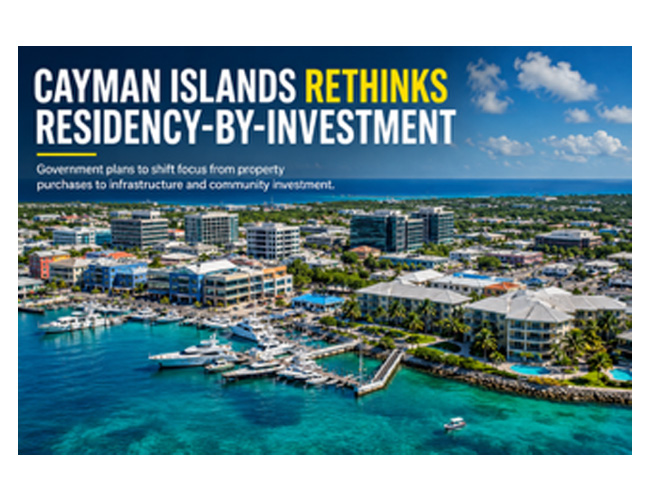
Premier André Ebanks has confirmed that the government is reviewing the territory’s residency-by-investment programme, with plans to reduce the emphasis on real estate ownership as the primary pathway to residency. Instead, policymakers are exploring ways to encourage investment into infrastructure projects, business development and community-focused initiatives that generate broader economic benefits for the islands.
For years, high-net-worth investors seeking residency in the Cayman Islands have largely achieved this through property acquisitions. While the programme has attracted substantial foreign capital, critics argue that it has also contributed to escalating land and housing prices, making home ownership increasingly difficult for many Caymanians.
Speaking about the planned reforms, Premier Ebanks said the existing system has become too heavily linked to real estate and that future investment pathways should create wider benefits for Cayman society. Government officials have indicated that infrastructure projects and other forms of community investment could become alternative routes for qualifying investors.
Immigration Minister Michael Myles was even more direct, suggesting that investment should be channelled into productive national development rather than simply purchasing land. According to Myles, the current model has contributed to property inflation and reduced affordability for local residents.
The proposed reforms form part of a broader immigration overhaul expected during the second half of 2026. Government is also reviewing the Permanent Residency Points System as part of its wider strategy to balance economic growth, housing affordability and long-term sustainability.
A Shift With Regional Significance
The move is being closely watched across the Caribbean, where several jurisdictions operate investment migration programmes linked to property purchases.
Supporters of the Cayman review argue that directing investor capital into infrastructure, renewable energy, public facilities and business expansion could create more lasting economic value while easing pressure on the housing market. Critics, however, will question whether reducing the role of real estate could dampen demand in one of the Caribbean’s most successful luxury property markets.
The Cayman Islands remains one of the world’s leading offshore financial centres and a highly attractive destination for international investors, entrepreneurs and wealth creators. The challenge for policymakers will be finding the right balance between welcoming investment and ensuring that economic growth benefits Caymanians as well as incoming residents.
The Bigger Picture
The debate reflects a wider global trend. From Europe to the Caribbean, governments are increasingly reassessing residency-by-investment schemes amid concerns over housing affordability, sustainability and social impact.
If implemented, Cayman’s reforms could become a model for a new generation of investment migration programmes—ones that reward investors for contributing directly to national development rather than simply acquiring property.
For now, all eyes are on George Town as the Cayman Islands considers a new formula for growth, investment and residency in one of the world’s most desirable financial and lifestyle destinations.
Cayman is not closing its doors to investors. It is simply asking a bigger question: should residency be earned by buying property, or by helping build the future of the country?
The answer could reshape not only the Cayman Islands, but the future of residency-by-investment programmes around the world.