 27 July 2026

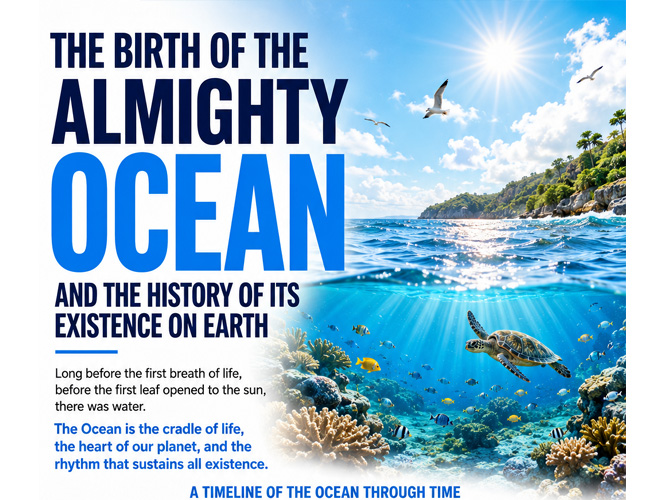
AND THE HISTORY OF ITS EXISTENCE ON EARTH
By Publisher Ray Carmen
Before the first tree rose towards the sunlight, before the first creature walked upon the land and before humanity ever looked towards the horizon, there was the Ocean.
Ancient, powerful and seemingly without end, it has witnessed almost the entire history of our planet. Continents have risen and broken apart beneath its gaze. Species have appeared, flourished and vanished within its depths. Civilisations have sailed across it, depended upon it and feared its immense power.
The Ocean is not merely a body of water.
It is the great regulator of Earth, the cradle of life and the living force that helped transform a violent young planet into the blue world we know today.

WHEN EARTH WAS A WORLD OF FIRE
Earth formed approximately 4.54 billion years ago from dust, rock and debris orbiting the young Sun.
The newborn planet was almost unrecognisable. Its surface was intensely hot, volcanic and repeatedly struck by asteroids and other objects left over from the formation of the Solar System.
There were no blue seas, green forests or living creatures.
There was only fire, molten rock, poisonous gases and an atmosphere filled with water vapour.
As the planet gradually cooled, enormous quantities of steam released by volcanic activity began condensing in the atmosphere. Rain may have fallen over immense periods, collecting within the lowest regions of Earth’s early crust.
Some of Earth’s water may also have arrived within water-bearing asteroids and other ancient Solar System material. Scientists continue to debate exactly how much came from Earth’s interior and how much was delivered from space.
The Ocean was therefore not born in one single dramatic moment.
It emerged slowly—from vapour, rain, volcanic gases, cooling rock and cosmic material—until water began gathering across the surface of the young Earth.
THE FIRST OCEANS
Tiny zircon crystals discovered in Western Australia provide some of the earliest surviving clues.
Their chemical composition suggests that liquid water may already have existed at Earth’s surface approximately 4.3 to 4.4 billion years ago, only a relatively short time after the planet itself was formed.
These ancient oceans would have looked very different from the seas of today.
The young Sun was fainter. Volcanoes were widespread. Continents were small or only beginning to form. Asteroid impacts remained frequent, and the atmosphere contained little or no free oxygen.
Yet water endured.
It filled deep basins, reacted with the crust, carried minerals across the planet and created an environment in which the chemistry of life could eventually begin.
WHEN THE OCEAN CAME TO LIFE
At some point more than 3.5 billion years ago, the Ocean ceased to be only water, minerals and chemistry.
Life appeared.
The first organisms were not fish, plants or animals. They were microscopic forms of life—simple cells capable of surviving in the ancient seas.
The precise place where life began remains one of science’s greatest unanswered questions. Possible environments include hydrothermal vents on the seabed, shallow coastal pools, hot springs, sea ice and other water-rich settings. No single birthplace has yet been conclusively proven.
Deep-sea hydrothermal vents remain one particularly compelling possibility. These underwater systems provide heat, minerals and chemical energy—ingredients that may have helped the earliest biological reactions develop.
Whatever the exact location, water was essential.
Every known living organism requires it.
The Ocean became the first great nursery of life on Earth.
THE OCEAN CHANGED THE ATMOSPHERE
For billions of years, microscopic marine organisms ruled the planet.
Among the most important were photosynthetic microbes capable of using sunlight to produce energy. As a by-product, they released oxygen.
Over immense periods, this oxygen accumulated in the oceans and atmosphere, fundamentally transforming Earth.
The process helped make complex life possible.
The oxygen we breathe today is therefore connected to an ancient biological revolution that began largely within the sea.
Even now, microscopic marine organisms known collectively as phytoplankton remain central to the planet’s oxygen, carbon and food cycles.
THE GREAT EXPLOSION OF MARINE LIFE
Around 541 million years ago, the fossil record reveals an extraordinary diversification of animal life known as the Cambrian Explosion.
The seas became populated by increasingly complex creatures—trilobites, early arthropods, sponges, worms and predators unlike anything that had existed before.
Later came corals, armoured fishes, sharks and immense marine ecosystems.
During the age of the dinosaurs, giant marine reptiles—including ichthyosaurs, plesiosaurs and mosasaurs—ruled portions of the seas.
Long after the non-avian dinosaurs disappeared, mammals returned to the water. Over millions of years, land-dwelling ancestors evolved into whales, dolphins and other marine mammals.
The Ocean had become home to some of the smallest and largest organisms ever to exist.
THE OCEAN AND THE MOVEMENT OF CONTINENTS
The Ocean has never remained still.
Its basins have opened and closed as tectonic plates moved across Earth’s surface.
Ancient supercontinents formed, fractured and drifted apart. New seas emerged between separating landmasses, while older oceans disappeared beneath continents through geological processes known as subduction.
The Atlantic Ocean began opening as the supercontinent Pangaea broke apart roughly 200 million years ago.
The shape of the world map is therefore temporary.
Millions of years from now, today’s oceans and continents will occupy entirely different positions.
THE OCEAN THAT RULES THE CLIMATE
Today, the Ocean covers approximately 71 per cent of Earth’s surface and contains around 96.5 per cent of all the planet’s water.
It absorbs enormous quantities of heat from the Sun and redistributes that heat through powerful currents.
These currents influence rainfall, temperatures, storms, monsoons and weather systems across the world.
The Ocean also absorbs carbon dioxide, stores heat, cycles nutrients and helps maintain conditions in which life can survive.
Without it, Earth would experience far more extreme temperature changes.
The climate systems upon which agriculture, cities and civilisation depend are inseparable from the sea.
THE OCEAN BUILT HUMAN CIVILISATION
Long before aircraft and modern roads, the Ocean connected continents.
It carried explorers, migrants, merchants, armies, religions, languages and ideas.
The Mediterranean linked some of the ancient world’s greatest civilisations. The Indian Ocean became a vast commercial highway connecting Africa, Arabia, India and Southeast Asia. The Atlantic later became central to global migration, empire, trade and conflict.
Coastal societies depended upon fishing, navigation and maritime knowledge.
Ports became centres of wealth and political power.
Even today, much of world trade moves by sea, while billions of people depend upon the Ocean for food, employment, transport and economic survival.
THE GREAT UNKNOWN
Despite its importance, much of the deep Ocean remains unexplored.
Its trenches contain extraordinary creatures adapted to crushing pressure, complete darkness and extreme cold.
Hydrothermal vents support ecosystems that do not depend directly upon sunlight.
New species continue to be discovered, reminding humanity that the largest living environment on Earth remains partly unknown.
The Ocean is therefore both our oldest companion and one of our greatest remaining frontiers.
AN OCEAN UNDER PRESSURE
For billions of years, the Ocean has survived asteroid impacts, shifting continents, ice ages, mass extinctions and enormous changes in climate.
Yet modern human activity is altering it at an unprecedented pace.
Pollution, plastic waste, destructive fishing, habitat loss, rising temperatures, declining oxygen levels and increasing acidity threaten marine ecosystems.
Coral reefs are under severe pressure. Coastal communities face rising seas. Many species are being driven towards dangerous decline.
The Ocean may appear limitless, but its capacity to absorb human damage is not infinite.
THE ETERNAL OCEAN
The story of the Ocean is the story of Earth itself.
It was present near the beginning of our planet’s history.
It became the cradle of life.
It helped create the oxygen-rich world in which animals and humanity could evolve.
It shaped continents, regulated climate, fed civilisations and connected the world.
Every river eventually seeks it.
Every raindrop participates in its endless cycle.
Every human life carries water that once moved through clouds, glaciers, rivers and ancient seas.
The Almighty Ocean has existed for more than four billion years—and unless humanity destroys the conditions that sustain its living systems, it will continue long after our own brief generation has passed.
THE OCEAN IS NOT MERELY PART OF EARTH.
IT IS THE LIVING HEART OF OUR BLUE PLANET.